“Don’t Buy GAP Insurance Online”… and Other Strange Things Dealers Tell Drivers
Buying a car should be straightforward.
But once you sit down in the dealership to finalise everything, the conversation usually shifts.
Finance, then Add-ons, then Protection products. PCPs, paint protection, tyre insurance, alloy wheel insurance and more.
There’s nothing wrong with that. GAP Insurance can be a valuable form of coverage.
But what’s interesting is what some drivers say they’ve been told when they say buying it from their dealer.
Over the years, we’ve heard some genuinely unusual claims - things that sound convincing in the moment, but don’t really stand up when you take a closer look.
Here are five of the most common (and strangest), along with what’s actually true.
1. “Don’t buy from a pre-COVID GAP Insurance company” 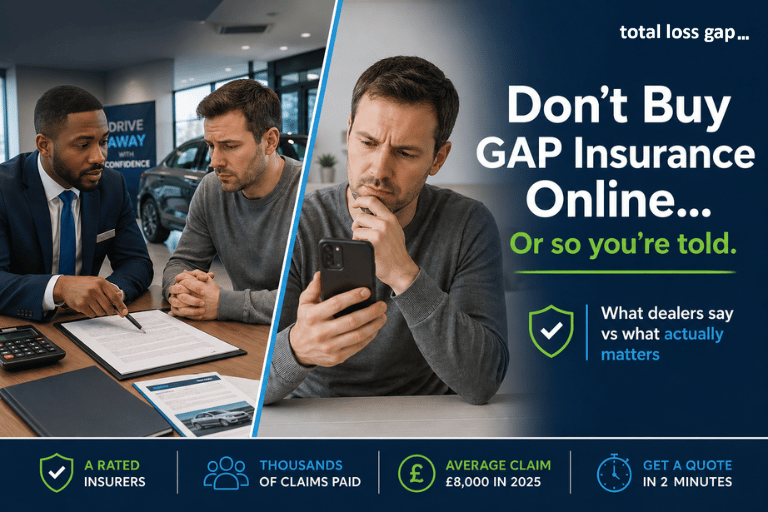
What this sounds like
You may hear something along the lines of:
“You need a post-COVID policy - older providers aren’t reliable anymore.”
What’s actually true
This isn’t how insurance works.
A GAP Insurance policy is a contract agreed at the point of purchase. It doesn’t become invalid or less reliable because of a global event, and there’s no recognised distinction between “pre-COVID” and “post-COVID” providers.
There have been regulatory changes in recent years, particularly around how GAP Insurance is sold, led by the Financial Conduct Authority.
But those changes relate to sales practices and fair value, not whether certain providers or policies are valid.
The reality
There’s no such thing as a “pre-COVID risk” when it comes to GAP Insurance.
What matters is the policy, the insurer behind it, and the terms you’re covered under.
2. “Online GAP companies are just based above a chip shop”
What this sounds like
“These online companies aren’t real - they’re small outfits with no backing.”
What’s actually true
This is usually about building doubt.
In reality, independent GAP providers, whether online or not, are typically:
- Authorised and regulated by the Financial Conduct Authority
- Selling policies underwritten by established insurers
- Operating nationally, not just locally
And here’s the part that often gets missed:
The dealer isn’t the insurer either.
They’re usually acting as an intermediary, selling a policy on behalf of an insurer, just like an independent broker would.
The reality
Where a company is based isn’t what matters.
Regulation, insurer strength, and policy quality are what count.
And if you would like to know about the stability of Aequitas Automotive Ltd, the business behind Total Loss GAP, you can read all about us in our
15th Anniversary in business.
3. “You’re not covered between midnight and 6 am”
What this sounds like
“If your car is stolen overnight, an online policy won’t pay out.”
What’s actually true
There is no standard GAP Insurance exclusion that limits cover based on the time of day.
GAP Insurance works alongside your motor insurer.
If your car is:
- Written off
- Or stolen and not recovered
…and your motor insurer settles the claim, then the GAP policy assesses the shortfall based on its terms.
The time the incident occurs is not a defining factor in whether a claim is valid.
The reality
If someone makes a claim like this, ask to see it in writing.
You won’t find it in standard policy documents.
4. “Online GAP providers never pay out”
What this sounds like
“They take your money and disappear when you need them.”
What’s actually true
This plays on a common concern around insurance in general.
But it overlooks how GAP Insurance is structured.
The policy you buy is typically underwritten by an insurer, not the website or broker you purchase through.
Claims are assessed based on:
- Your motor insurer’s settlement
- The GAP policy wording
- The circumstances of the loss
Many independent providers publish:
- Verified customer reviews
- Claims statistics
- Average payout figures
This gives a clearer picture of real-world performance.
The reality
GAP Insurance pays out when the policy terms are met.
The key is choosing the right policy, not where you happen to buy it.
5. “Make sure it’s a managed policy, not unmanaged”
What this sounds like
“Online policies are unmanaged, and that’s risky.”
What’s actually true
This sounds technical, which is why it can be persuasive.
But in practice, “managed” vs “unmanaged” isn’t a clearly defined or widely recognised distinction in GAP Insurance policies.
It’s often used as a way to suggest:
- Dealer policies have more oversight
- Online policies lack support
In reality, all regulated GAP Insurance products must meet the same standards, regardless of where they’re sold.
The reality
If a term isn’t clearly defined in the policy documents, it’s not something you can rely on when it matters.
Always ask for the full policy wording and check what’s actually covered.
What They Don’t Tell You About GAP Insurance
After hearing all the warnings about buying GAP Insurance elsewhere, there are a few things that don’t always get mentioned.
And these can have a real effect on both cost and cover.
You may pay a higher rate of tax in a dealership
GAP Insurance sold alongside a vehicle is often treated as a retail add-on, which can attract a higher Insurance Premium Tax rate.
In many cases:
- Dealer-sold GAP Insurance can be subject to 20% IPT
- Standalone policies bought independently are typically 12% IPT
That difference is built into the price, even if it’s not shown separately.
The insurer and claims process are often the same
There’s a common perception that dealer-sold policies are somehow more secure.
But in many cases, both dealer and independent GAP policies:
- Use the same insurers
- Follow the same claims process
So the difference isn’t “who pays out”.
It’s what you’re paying, and what cover you’re getting.
Not all insurers are equal, and this isn’t always highlighted
Some GAP Insurance policies, particularly those sold in dealerships, can be underwritten by unrated insurers.
That doesn’t mean they won’t pay claims, but it does mean there’s less visibility around financial strength.
By comparison, some providers choose only to offer cover backed by insurers with strong credit ratings.
You usually get more choice, and price, online
In a dealership, you’re often presented with:
- One option
- One price
- One structure of cover
Buying independently gives you more flexibility.
You can typically choose:
That means you can match the cover to your situation, rather than taking a one-size-fits-all option.
Real claims can be larger than expected
Many drivers underestimate the size of a possible GAP claim.
But with modern vehicle prices and depreciation, the shortfall can be significant.
In 2025, the average GAP Insurance payout was around £8,000.
That’s not a small top-up, it’s a meaningful financial difference if your car is written off.
You don’t have to decide on the spot
GAP Insurance is often offered when you’re already making a major purchase.
But you don’t usually have to decide there and then.
Most drivers have a window after buying their car to arrange cover, giving time to:
- Compare options
- Read policy documents properly
- Choose what actually fits
The Bottom Line
There’s nothing wrong with buying GAP Insurance from a dealer.
But it’s not the only option, and it’s not always the most flexible or cost-effective one.
Once you focus on what really matters:
- The insurer behind the policy
- The level of cover
- The price you’re paying
- And the potential size of a claim
…it becomes much easier to make a clear, informed decision.
And if something you’re told sounds unusual, it’s always worth asking one simple question:
“Can you show me where that’s written in the policy?”