Chinese EV Insurance Costs Rising in the UK: What Drivers Need to Know
Chinese electric and hybrid vehicles are becoming increasingly common on UK roads. Brands such as BYD, XPeng, Omoda and Jaecoo have expanded rapidly over the past 18 months, attracting buyers with competitive prices, impressive technology and generous equipment levels.
Some models have become major sales successes almost overnight. In March 2026, the Jaecoo 7 was reportedly the UK’s best-selling new car.
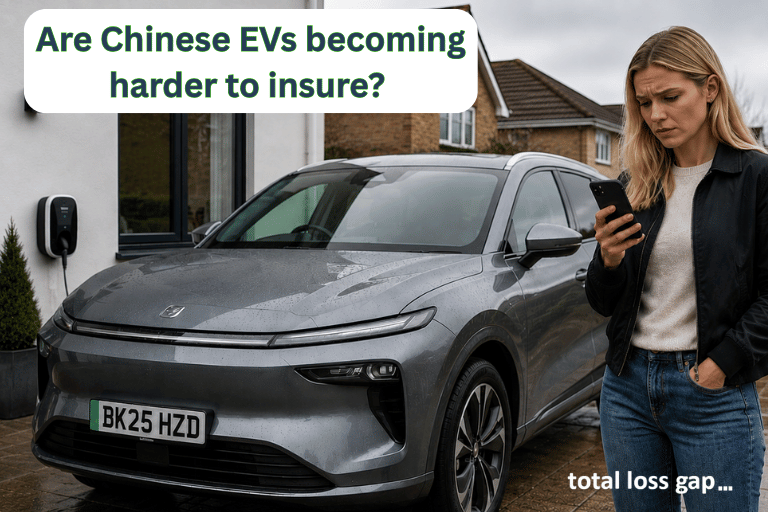
However, while lower purchase prices are helping many drivers move into electric vehicles for less money, some buyers are now discovering an unexpected issue after placing an order: insurance.
Recent reports suggest that certain Chinese EV and hybrid vehicles are proving more difficult and expensive to insure than equivalent vehicles from more established manufacturers.
Chinese EV Brands Are Growing Rapidly in the UK
Chinese manufacturers are no longer niche players in the UK market.
Brands including
BYD, MG, Omoda, Jaecoo and XPeng are now competing directly with established European, Japanese and Korean manufacturers. In many cases, they are offering high levels of equipment and technology at prices that undercut many traditional rivals.
The UK market has become especially appealing to Chinese brands because demand for more affordable electric vehicles stay strong, while established manufacturers continue to attract criticism over rising prices.
Why Are Some Chinese EVs More Difficult to Insure?
The issue does not appear to be about Chinese vehicles being unsafe or poorly built. Instead, insurers are facing a rapidly changing market in which entirely new vehicle brands are arriving in the UK lacking the long-term claims and repair data that insurers usually rely on.
According to research from Carwow, some insurers either declined to quote for certain Chinese EV models or offered significantly higher premiums than equivalent mainstream alternatives.
Insurance pricing is heavily affected by historical claims information. When manufacturers have sold vehicles in the UK for many years, insurers have access to extensive data covering repair costs, theft rates, write-off trends and claims frequency.
Many newer Chinese brands do not yet have this level of UK market history.
The Association of British Insurers reportedly stated that a limited claims history can make it harder for insurers to accurately assess risk.
Repair Costs and Parts Availability
Another major factor appears to centre around repair logistics.
Modern electric vehicles can already be expensive to repair due to battery systems, specialist labour requirements and advanced technology. For newer brands entering the UK market, insurers may also be considering how quickly replacement parts can be sourced and how widespread authorised repair networks are across the country.
If repairs take longer or need imported specialist components, overall claim costs can rise sharply.
Some insurers reportedly cited underdeveloped parts supply chains and limited repair infrastructure as reasons for caution.
This is particularly relevant in the electric car market, since even minor collisions can lead to large repair bills or vehicle write-offs.
Insurance Costs Can Be Significantly Higher
An article by Carwow highlighted that some Chinese EVs were increasingly more expensive to insure than comparable mainstream vehicles.
According to a report in The Guardian, the average annual insurance cost for the Chinese vehicles studied was around £901, compared with roughly £646 for comparable petrol rivals. One Jaecoo 7 quote reportedly exceeded £1,100, while a comparable Skoda Karoq was quoted at around £577.
It is important to note that insurance premiums vary depending on factors such as postcode, age, occupation, mileage and driving history. Not every driver will experience unusually high premiums, but the research suggests some insurers stay wary of certain newer models.
Some Insurers Are Declining Quotes Entirely
One of the more surprising findings from recent reports is that some insurers declined to quote for certain models altogether.
The Carwow research suggested Axa declined all four tested Chinese models, while Hastings Direct only quoted for one. Admiral reportedly declined to quote one model, whereas Aviva was willing to quote all four vehicles involved in the research.
This does not necessarily mean these cars are uninsurable. Rather, it suggests some insurers are still deciding how to price and manage the risks associated with rapidly emerging brands.
This Is Not Entirely New
Several industry figures have pointed out that similar concerns existed when Japanese and Korean manufacturers first entered the UK market decades ago.
At the time, insurers also faced uncertainty around repair costs, parts supply and resale values. As those manufacturers became more established and insurers gathered more claims data, insurance availability and pricing gradually improved.
Manufacturers such as Omoda and Jaecoo have reportedly stated that they are working closely with insurers to improve confidence in repairs, parts supply, and claims handling.
Could This Affect Depreciation?
Insurance affordability can directly affect used-vehicle demand. If a vehicle becomes expensive to insure, some buyers may avoid it altogether, which can place downward pressure on resale values.
This is particularly important in the EV market, where depreciation has already become a major talking point over the past two years.
A combination of falling new EV prices, fast technological change, repair-cost uncertainty and insurance concerns could all contribute to stronger depreciation on certain vehicles.
For motorists financing or leasing newer EVs, knowing future resale values is becoming increasingly important.
What Should Buyers Do Before Ordering a Chinese EV?
Chinese EVs can still represent excellent value for many motorists. However, buyers should avoid focusing purely on the vehicle purchase price.
Before placing an order, it may be sensible to obtain insurance quotes, check and research local repair support, and understand how depreciation could affect future ownership costs.
This is especially important for drivers using finance, lease or PCP agreements, where depreciation and insurance settlement values can have a major financial impact after a write-off or theft.
The benefit of
GAP Insurance is also brought into sharp focus when depreciation is associated with any particular vehicle or group of vehicles. Currently, Chinese EV's are no more expensive to get GAP Insurance for with Total Loss GAP than their counterparts in the market.
Final Thoughts
Chinese EV manufacturers are likely to become a permanent and significant part of the UK car market.
Their attractive pricing, improving technology and expanding dealer networks are already reshaping the automotive industry.
However, the insurance market is still catching up.
For now, some drivers might find certain Chinese EVs more expensive or more difficult to insure than expected, particularly where insurers have limited repair and claims data.
That does not mean these electric vehicles should be avoided altogether. However, it highlights the importance of researching the full cost of ownership before buying, rather than focusing solely on the monthly payment or the headline purchase price.
Sources