Does GAP Insurance Cover Factory-Fit Options and Dealer Extras?
Yes, GAP Insurance can cover factory-fit options and dealer-fitted extras, but only if they are included in your vehicle’s original purchase price or invoice.
The level of cover depends on the type of GAP policy you choose and how the vehicle’s value is assessed at the time of a claim.
At
Total Loss GAP, policies can include all factory-fitted options and up to £1,500 of eligible dealer-fitted accessories, provided they are listed on the original sales invoice.
What Counts as Factory-Fit Options and Dealer Extras?
When considering what is covered, it’s important to understand how options and extras are classified.
Factory-fit options are features added by the manufacturer before delivery, such as upgraded alloys, technology packs, special paint finishes or panoramic roofs.
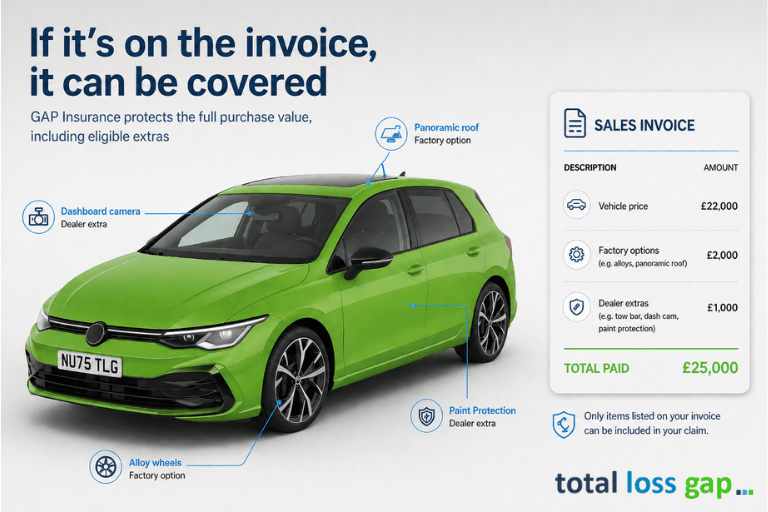
Dealer-fitted extras are items added by the supplying dealer before or at the point of sale, such as tow bars, paint protection*, or dash cams.
In most cases, these are only covered if they form part of the declared purchase price of the vehicle.
*Paint protection is not always covered by all providers, but many Total Loss GAP policies can include it where it appears on the sales invoice. Always check your policy terms.
When does GAP Insurance cover options and Extras?
Return to Invoice (RTI) GAP Insurance
RTI GAP Insurance is designed to cover the difference between your motor insurer’s payout and the original amount you paid for the vehicle.
Factory options and dealer extras are usually covered if they are clearly included on your purchase invoice.
If an item isn’t listed on the invoice, it typically won’t form part of your claim settlement.
If your outstanding finance balance is higher than your invoice price at the time of claim, some policies may settle to the finance amount instead.
Vehicle Replacement (VRI) GAP Insurance
Vehicle Replacement GAP covers the cost of replacing your car with one of a similar age, mileage, and specification at the time of a total loss.
This may include equivalent options and features, but the settlement is based on current market replacement costs rather than what you originally paid.
Not every individual extra may be reflected exactly, especially if specifications or availability have changed.
When Might Options and Extras Not Be Covered?
There are situations where options and extras may not be included in a GAP claim.
Items added after you purchased the vehicle
Extras not shown on the original invoice
Undeclared modifications or upgrades
Removable or non-permanent accessories
Insurance-backed items like alloy wheel or tyre insurance
Service or maintenance plans
Standalone protection products not included in the vehicle invoice
GAP Insurance is designed to protect a defined vehicle value, not to add value beyond what can be evidenced at the time of purchase or replacement.
The GAP claim is based on the original invoice value (or replacement cost, depending on the cover), not the individual resale value of each extra.
Example: How Options Are Treated in a Claim
You purchase a vehicle for £25,000, including £2,000 of factory-fit options and £1,000 of dealer accessories.
If the car is written off:
Your motor insurer pays the current market value (e.g. £18,000)
Your GAP policy covers the shortfall back to £25,000 (RTI)
Because the options and accessories were included in the original invoice price, they are factored into the GAP settlement.
Key Takeaway
GAP Insurance does not add value for extras. It protects the value already built into your vehicle’s purchase price or replacement cost.
Related Questions About GAP Insurance
Does GAP Insurance cover aftermarket parts?
What does GAP Insurance cover you for?
GAP Insurance covers the financial shortfall between your motor insurer’s payout and either the price you paid for your car or the cost of replacing it, depending on the policy type.
What is not covered under GAP Insurance?
GAP Insurance does not cover mechanical failures, wear and tear, or non-total-loss situations. It only applies when a vehicle is written off or stolen and declared a total loss. GAP Insurance does not cover all situations, and
may not be worthwhile to every vehicle owner.
Check Your Cover Options
If your vehicle has optional extras or upgrades, it’s worth making sure they are properly reflected in your GAP cover.
Reviewed by
Mark Griffiths, Founding Director and Insurance expert
Last reviewed: 28th April 2026