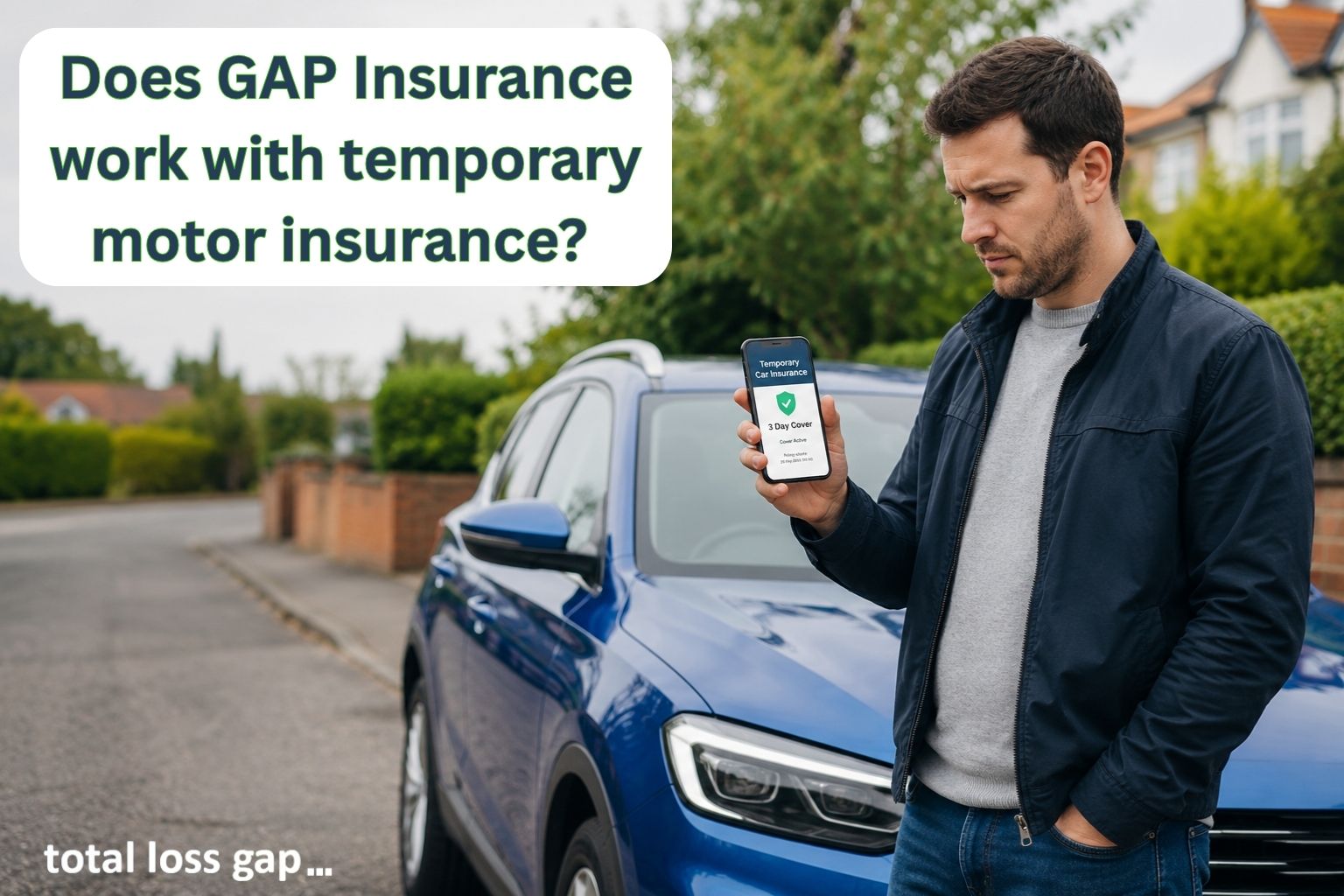
Does GAP Insurance Cover Short-Term or Temporary Insurance Policies?
Usually not.
In most cases,
GAP Insurance will not work alongside short-term or temporary motor insurance policies.
This is because GAP Insurance relies on your main motor insurer accepting and settling a total-loss claim under a full comprehensive motor insurance policy. Temporary or short-term insurance is not normally treated as suitable long-term cover for this purpose.
GAP Insurance also normally requires you to be continuously insured for the duration of the policy. This may not be the case if you are using temporary car insurance.
If your vehicle is insured only under temporary cover at the time of a write-off or theft, your GAP Insurance provider may refuse the claim.
Why Does GAP Insurance Need a Main Motor Insurance Policy?
GAP Insurance is designed to sit alongside your comprehensive motor insurance policy.
It works by covering some or all of the financial shortfall between:
- your motor insurer’s payout
- and the amount protected under the GAP policy
For example:
- the original invoice price
- replacement vehicle cost
- or outstanding finance balance
Because of this, the GAP insurer normally expects:
- a valid annual comprehensive motor insurance policy
- the vehicle to be insured correctly
- the main insurer to accept the claim in full
If the motor insurer declines the claim, GAP Insurance would not normally pay out either.
You may also want to read:
What Counts as Temporary Car Insurance?
Temporary or short-term car insurance usually refers to policies lasting:
- one hour
- a few days
- a few weeks
- or a few months
These policies are commonly used for:
- borrowing a vehicle
- test driving a car
- temporary vehicle use
- learner driver cover
- sharing driving duties
While they can provide legitimate road insurance, they are not normally intended to replace a permanent annual motor insurance policy linked to GAP Insurance.
What If I Already Have GAP Insurance?
If you already have GAP Insurance in place, the vehicle must remain covered by suitable comprehensive motor insurance for the duration of the policy.
Some GAP Insurance providers may allow temporary additional drivers or short-term supplementary insurance in certain situations, but this does not usually replace the requirement for a permanent annual motor insurance policy.
Policy wording can vary between insurers, so you should always check the terms and conditions carefully.
Why Might a GAP Claim Be Refused?
A GAP Insurance claim could potentially be refused if:
- the vehicle only had temporary insurance in force
- the main insurer declines the total-loss claim
- the vehicle was not insured correctly
- the policyholder did not maintain valid comprehensive motor insurance
Because GAP Insurance relies on the main insurer’s settlement, any issue with the underlying motor insurance can affect the GAP claim as well.
Related guides:
Are There Any Exceptions?
Possibly.
Some insurers may take different approaches where:
- temporary cover was supplementary rather than primary insurance
- the vehicle still had a valid annual policy in force
- the temporary policy related to an additional driver only
However, this varies by insurer and policy.
You should never assume temporary insurance will automatically satisfy the motor insurance requirements of a GAP Insurance policy.
The Bottom Line
GAP Insurance does not usually work with short-term or temporary motor insurance policies on its own.
Because GAP Insurance relies on a full comprehensive motor insurance settlement after a total loss, most providers expect the vehicle to be covered by a valid annual motor insurance policy throughout the period of cover.
Always check the specific policy wording carefully if temporary insurance is involved.
Reviewed by
Mark Griffiths, Founding Director and GAP Insurance expert
Last reviewed: 12th May 2026