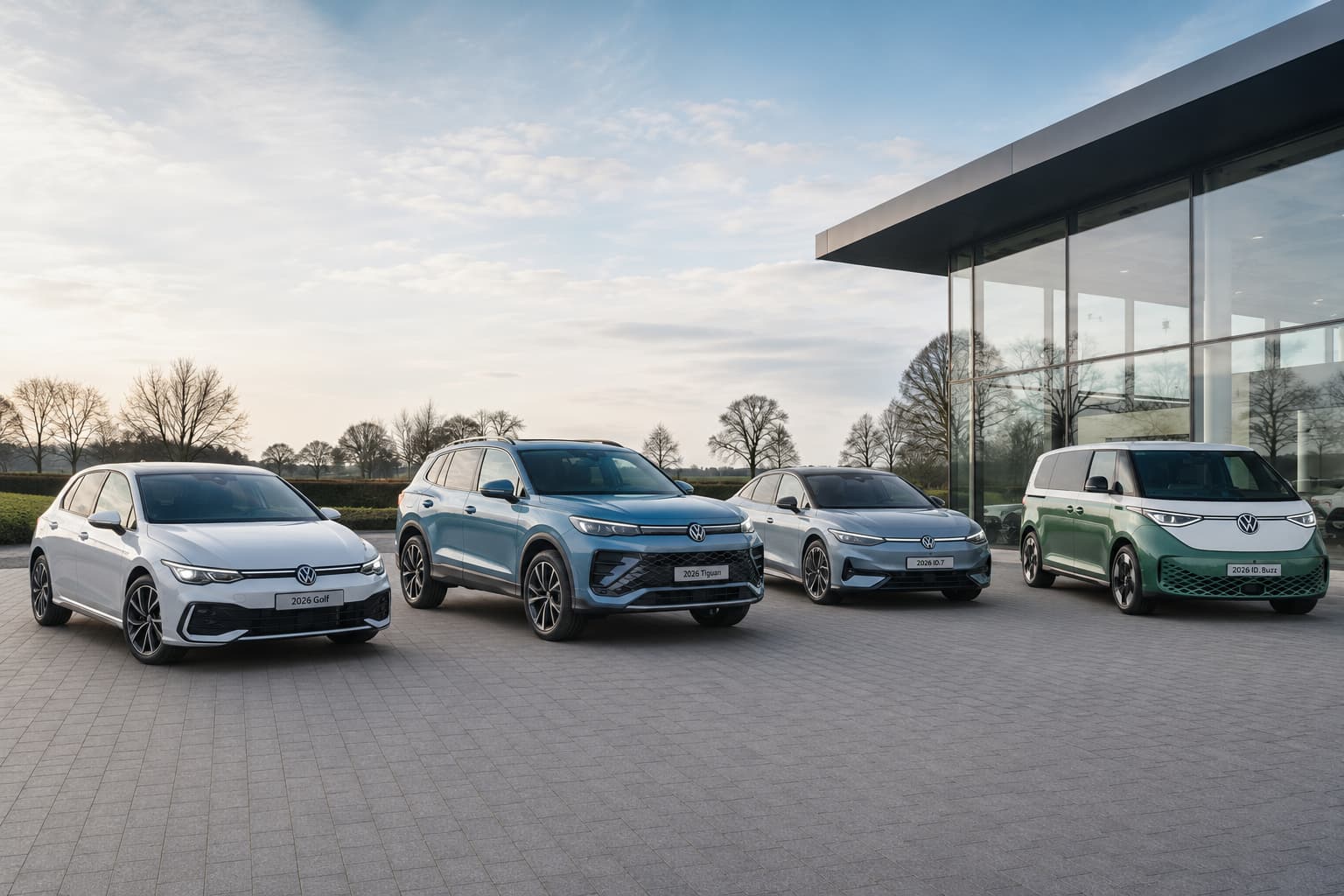
Volkswagen to reduce it's model line up by 2030 - here is how
Volkswagen Group intends to reduce its global model range by as much as half, and to cut the number of equipment and trim combinations by up to 75%.
If you own a Volkswagen, Audi, Skoda, Seat or Cupra, the immediate message is reassuring. Your car is not about to become obsolete. Dealers will not stop supporting it. Nothing disappears overnight.
The longer view is murkier. Over the next few years, UK buyers will see fewer models, fewer trim levels and a thinner options list. Some of the cars that get dropped will hold their value perfectly well. Others may not, if buyers start worrying about demand, software support or the absence of a replacement.
That uncertainty matters more than the headline number.
What Volkswagen Group has announced
The executive board put the proposals to Volkswagen Group's supervisory board on 9 July as part of a wider future plan.
The group says it will cut its global model portfolio by up to 50% and concentrate on the segments that make the most money. Variety in equipment and specifications falls by as much as 75%.
Chief executive Oliver Blume called it the next stage of the group's transformation, promising a faster, more competitive Volkswagen carrying less overcapacity.
The more revealing quote came from the chief financial officer. Arno Antlitz said the cost reductions already agreed are no longer sufficient in the current environment.
Read that again. Volkswagen has spent three years cutting, and has just conceded that the cutting did not go far enough.
For scale, the group runs around 150 model lines across Volkswagen, Audi, Skoda, Seat, Cupra, Porsche and Volkswagen Commercial Vehicles. Halving that is not housekeeping.
What was not announced
No list of cars. No detail on how any of this lands in individual markets, including the UK.
Wider restructuring has also been reported, including factory closures and heavy job losses in Germany. Those proposals met firm resistance from employee representatives and were not confirmed in Volkswagen's official statement.
The distinction is worth holding onto. The product cuts were made public. The decisions about factories and jobs remain under negotiation.
There is a structural reason for that. Under Germany's co-determination system, employee representatives hold half the seats on the supervisory board. Which means the unions did not merely object to the deeper cuts. They had the votes.
Why Volkswagen is cutting back
The numbers underneath explain the urgency.
Group deliveries fell 8.6% in the second quarter of 2026 against the same period a year earlier. In China, the fall was 36.6%. Chinese manufacturers have become much stronger, particularly in electric cars, while tariffs, regulations, and half-empty factories keep pushing costs up.
Volkswagen now aims for an annual capacity of around 9 million vehicles. Before the pandemic, it was equipped to build roughly 12 million.
The share price tells its own story, down more than 30% since the start of 2026.
None of which means the company is failing to sell cars. It sold millions last quarter. The problem is not building them. It is building this many different versions of them at a profit.
Which Volkswagen Group cars could disappear
Volkswagen has not named a single model.
Some of the shrinkage is already visible, though. The Touareg and Touran have gone. The T-Roc Cabriolet follows in 2027. Audi has dropped the A1 and Q2, after the earlier departures of the TT, R8 and Q8 e-tron. Porsche ended production of the petrol 718 Boxster and Cayman in October 2025.
Other names get mentioned in the motoring press, the Volkswagen ID.5 and Audi A8 among them, though reports vary by market. Performance cars such as the Golf GTI and Golf R sell in small numbers, but heritage and brand value may keep them alive.
Treat all of that as informed speculation. Volkswagen has not said what goes next, and until it does, nobody outside Wolfsburg knows.
What it could mean for UK showrooms
The effects will creep rather than arrive.
Cars are rarely pulled without warning. What usually happens is quieter. A model reaches the end of its production cycle and simply is not replaced.
So UK dealers will offer fewer models, fewer engines, fewer trims and fewer option combinations over the next few years. The car you can buy today may stay on sale for a while yet. You will notice the change later, when its successor never turns up.
For some buyers, that is a relief. Modern ranges can be baffling, with dozens of near-identical versions of the same car.
For others, it will sting. Estates, coupés, convertibles and MPVs sit outside the segments Volkswagen has said it wants to keep.
Could discontinued models lose value?
There is no simple answer, and anyone who gives you one is guessing.
A discontinued car does not automatically collapse in value. Some stay popular precisely because production has ended, and tidy used examples get harder to find.
Others fall hard. The Renault Zoe has been named the UK's worst performer for depreciation, with three-year-old cars retaining around 30% of their original price. That cannot be pinned on discontinuation alone. Older battery technology, newer rivals and a wider correction in used EV prices all played a part.
Where any particular Volkswagen Group model lands will depend on several things:
- how popular it was before production ended;
- whether it has a direct replacement;
- parts and software support;
- how reliable it turns out to be;
- whether buyers still want it;
- how quickly its technology dates.
A well-liked petrol performance car could stay desirable for years. A slow-selling electric model on older battery technology has a harder road. The badge on its own decides nothing.
Why buyers should pay attention to residual values
Residual value is what a car is expected to be worth in future. It shapes used-car prices, trade-in values, lease costs, and monthly finance payments.
If buyers lose confidence in a model, that hesitation eventually shows up in trade values.
This does not mean every discontinued Volkswagen Group car will fall unusually fast. Some will beat expectations. What it does mean is that predicting future values gets harder, particularly for cars withdrawn without a clear successor.
What this means if you have a PCP agreement
A PCP agreement includes a predicted future value, usually called the Guaranteed Future Value or optional final payment.
At the scheduled end of the agreement, the customer can normally return the vehicle rather than pay the final amount, subject to the agreed mileage, condition, and other contractual terms.
If the car is worth less than its Guaranteed Future Value at that point, the customer does not normally have to pay the difference, even if the vehicle depreciated more than expected.
The protection offered by the GFV does not normally apply in the same way if the customer settles or changes the car early.
An early finance settlement may exceed the car's current trade-in value. If that happens, the customer is in negative equity and may need to pay the difference, continue with the agreement or, where permitted, include the shortfall in a new finance arrangement.
A similar issue can arise if the vehicle is written off before the finance agreement ends.
What happens if a financed car is written off
When a vehicle is written off, the motor insurer will normally base its settlement on the car's market value immediately before the loss.
That is not necessarily the same as:
- the price originally paid for the car;
- the cost of buying a replacement;
- or the amount still outstanding on the finance agreement.
If the insurer's settlement is lower than the finance settlement, the customer may remain responsible for the difference.
A sharper-than-expected fall in used values can increase the chance of a shortfall if the vehicle's market value falls more quickly than the outstanding finance balance.
There is no evidence that Volkswagen Group's restructuring will automatically cause widespread financial shortfalls. The effect will vary between models and may take several years to become clear.
The risk is nevertheless worth understanding.
Where GAP Insurance may help
GAP Insurance is designed to provide additional protection following a total loss, subject to the policy type, limits, exclusions and terms.
Return to Invoice GAP Insurance can cover the difference between the motor insurer's settlement and, depending on the policy wording, the higher of the original invoice price or eligible outstanding finance.
Vehicle Replacement GAP Insurance can instead cover the difference between the insurer's settlement and the cost of replacing the written-off vehicle with an equivalent new model. It should also be noted that the Vehicle Replacement GAP from
Total Loss GAP also contains a feature that, if a replacement model is no longer available (where it may have been discontinued), the original price plus 10% will be used as a replacement cost valuation. Other VRI products on the market may revert to the original invoice price, resulting in a 10% lower payout to you.
Lease GAP Insurance is designed for vehicles funded through contract hire or leasing and can help cover an eligible shortfall between the insurer's payment and the lease settlement.
Not every amount included within a finance settlement will necessarily be covered. Previous negative equity, arrears, late payment charges, and other fees may be excluded.
Customers should always check the specific policy wording rather than assuming that every finance shortfall will be paid.
Could a discontinued Volkswagen become harder to insure or repair
Discontinuation does not automatically make a car difficult to insure.
Existing vehicles can continue to be insured, serviced and repaired long after production ends. Manufacturers and parts suppliers normally continue to support cars already on the road.
Parts availability can become more difficult over a much longer period, particularly for rare models, unique body panels or specialist electronic components.
Software support may also become an increasingly important consideration for electric cars and vehicles that rely heavily on connected systems.
However, there is currently no reason for owners of existing Volkswagen Group cars to assume that normal servicing, insurance or repairs will suddenly become unavailable.
What should UK buyers do?
Nobody needs to sell a perfectly good car because of a board meeting in Germany.
But if you are buying a Volkswagen Group model soon, a few questions are worth asking.
Ask the dealer whether the model has a confirmed successor, and how long the current version is expected to stay in production.
Check the gap between what the car is worth today and what you owe under any finance agreement.
Think about how easy it will be to sell later, particularly if it is a low-volume model or runs technology that is already being superseded.
And read the specification sheet properly. If equipment choice is being cut by up to 75%, the well-specified version you want may not be orderable for much longer.
The bottom line
Volkswagen has not forgotten how to build good cars.
It has forgotten how to make money building this many of them, across this many brands, on this many platforms, while competition and costs keep climbing.
The reduction will take years, not months. For UK drivers, the likely result is fewer models, less choice on the options list, and more doubt about what certain cars will be worth further down the line.
Some discontinued models will stay desirable. Others will slide.
Nobody yet knows which will be which, and that is precisely why anyone buying on finance should be paying attention to depreciation, early settlement figures and what a total loss would actually cost them.
Sources :