Call Monday-Friday 9am - 5pm Closed Weekends & Bank Holidays
The Mini: A Small Car With a Very Big Story
Ask anyone over fifty what car they remember most from their childhood and there's a decent chance the answer is a Mini. Not because it was the best car on the road. It wasn't, not really. But it was everywhere, it was cheap, and if you were lucky enough to be in one when the driver knew what they were doing, it was the most fun you could have at 40 miles per hour.
That probably tells you everything about why this car has lasted sixty-five years.
It Started With a Political Crisis
The Suez Crisis, 1956. Britain and France became embroiled in a military intervention in Egypt, petrol prices were rising, and small "bubble cars" imported from Germany suddenly appeared on British streets.
Leonard Lord, the boss of the British Motor Corporation, wanted a small, economical car as a solution.
His solution was to hand the problem to Alec Issigonis.
Issigonis was the kind of engineer who trusted his own judgement completely, sometimes to a fault. He didn't do focus groups. He sketched ideas on napkins and argued about them with a small team. What he came up with for BMC was genuinely strange by the standards of the time: an engine mounted sideways, wheels pushed right out to the corners, rubber cone suspension instead of conventional springs. The whole car was ten feet long. You could park two of them in the space one family saloon needed.
Yet despite its tiny footprint, four adults could fit inside with surprising comfort. The layout proved so effective that it became the blueprint for countless small cars that followed.
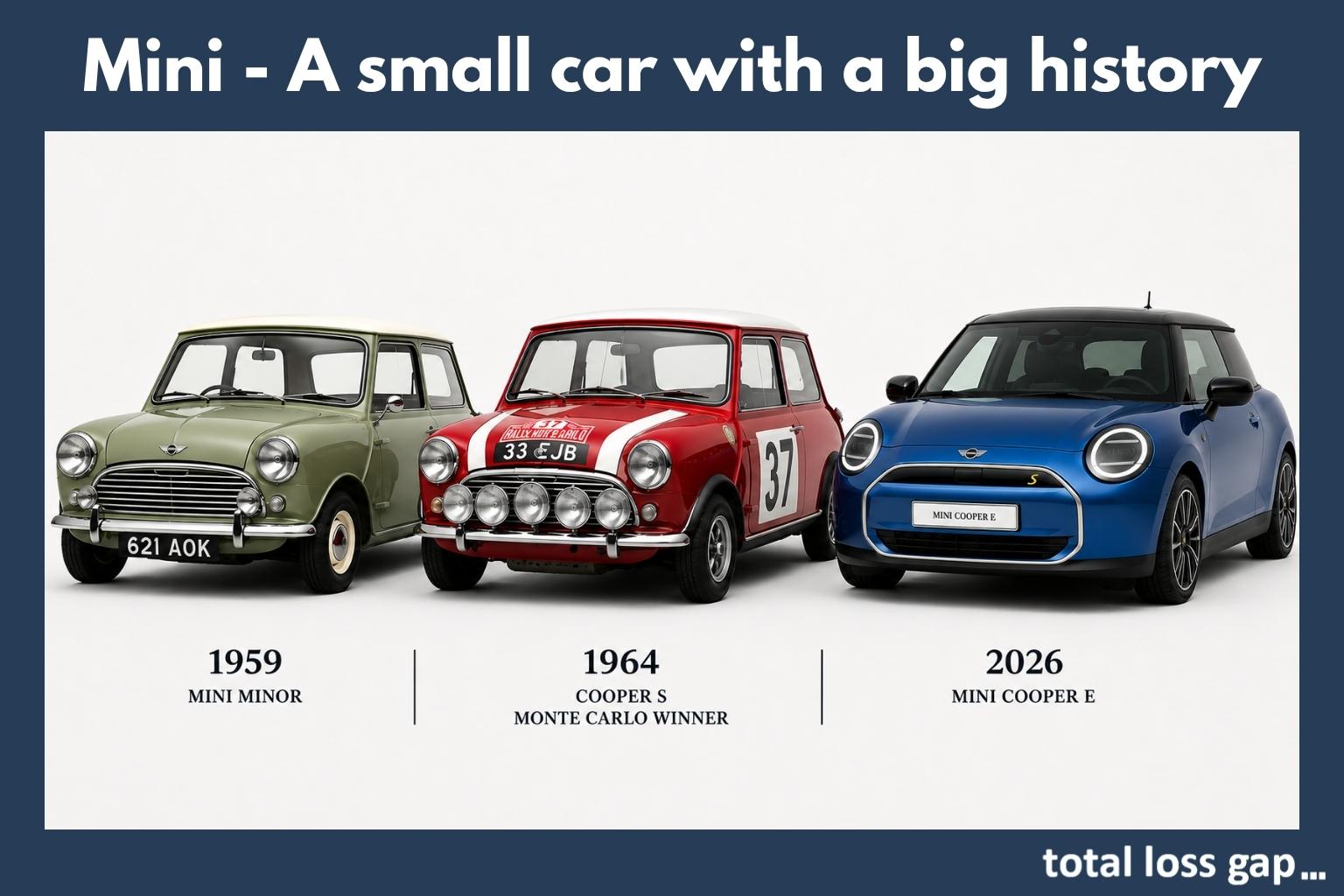
The Austin Seven and Morris Mini-Minor went on sale in August 1959, priced at £496. It was rumoured that BMC had actually miscalculated and was selling each unit at a loss, although this was never confirmed.
Whether BMC would ever make much money from it was another question. Culturally, though, it turned out to be almost perfect.
The Sixties Were Good to It
The car took a while to catch on. Early buyers had reservations: the doors were oddly hinged, water got into the electrics, and the ride was firm in a way that suggested the suspension was making a point. But once people actually drove it, something clicked.
More importantly, it handled. Really handled. The low centre of gravity and that unusual geometry meant you could push it into corners in a way that felt nearly reckless. For ordinary drivers on ordinary British roads, it became a revelation.
John Cooper noticed. He was already famous for his Formula One constructors' championship wins, and he could see immediately what the Mini's chassis was capable of. He went to BMC, made his case, and in 1961 the Mini Cooper appeared. Two years later, the Cooper S. That car won the Monte Carlo Rally in 1964, 1965, and 1967. It would arguably have won the 1966 rally too, had several Minis not been controversially disqualified over a headlamp technicality.
It beat Porsches. It beat Fords. Larger, more powerful, more expensive cars driven by professional works teams.
Meanwhile, in London, the Mini had become something nobody planned for. Twiggy drove one. The Beatles owned several. Peter Sellers reportedly had seven at one point, which feels excessive even for Peter Sellers. And then in 1969 came The Italian Job, and three Minis spent ten minutes driving through sewers, up staircases and across rooftops in Turin while a brass band played. If you haven't seen it, stop reading this and go and watch it. I'll wait.
The Difficult Middle Years
Here's where the story gets less triumphant.
British Leyland absorbed BMC in 1968 and the Mini became one of dozens of models in an extensive, badly managed company that was fighting fires on every front. Evolution was minimal. The car was updated in small increments but never seriously rethought. By the mid-1970s, the VW Polo had arrived. Then the Ford Fiesta. Then the Renault 5. These were modern cars with modern build quality. The Mini was still essentially Issigonis's original design, and was now fifteen years old.
It could have died. By any rational product-planning logic, it should have been killed off in the late 1970s and replaced with something genuinely new. Instead, British Leyland kept it going on a shoestring, Rover Group after them did the same, and the car accumulated an unusual kind of longevity through sheer inertia and the fact that people were oddly attached to it.
Special editions appeared constantly. A 25th anniversary edition. A 30th. A 35th. A 40th. Each one announced with the energy of a company trying to convince itself that the car still mattered.
The last classic Mini was built on 4th October 2000. 5.38 million had been made.
BMW's Gamble
BMW bought Rover Group in 1994, found it to be in considerably worse shape than expected, and by 2000 had sold most of it off. They kept two things: the rights to build Rolls-Royces, and the Mini name. At the time, some people questioned whether the Mini name was actually worth keeping. It turned out to be worth quite a lot.
The new MINI (capitalised, deliberately distanced from the original) launched in 2001. Frank Stephenson designed it with what he described as a respectful nod to the classic predecessor: round headlights, compact proportions, that go-kart stance. It was larger than the classic, which annoyed purists. It was also better built, better equipped, and genuinely good to drive, which annoyed them further because it made their argument harder.
The Cooper S came back. The convertible came back. The car sold well in markets the original MINI had never really cracked, particularly America.
Where It Is Now, and Whether That's a Good Thing
This is where I'll admit to some ambivalence.
The MINI range has expanded over the years to include Convertibles, Clubmans, Countrymans and numerous other derivatives. The Countryman, in its latest form, is a family car weighing around 2 tonnes. Alec Issigonis designed a car specifically because large cars were wasteful and impractical. There is something almost comic about where the brand has ended up.
And yet the core hatchback is still good. The latest generation is available as a full electric, the MINI Cooper E, and it's arguably the best version of the modern car. The instant torque suits it perfectly. It's quick, it's responsive, and it still has that quality the original possessed: it makes you want to drive it harder than you probably should.
Modern MINIs are considerably more expensive than the original concept ever intended, with even entry-level models now positioned as premium small cars. So no, it's not a car for everyone anymore, but it still represents good value compared with many similarly premium small cars. And at a time when the fun may have been lost in many cars, MINI says the car still can give you the ‘go-kart’ feeling. (See the Top 10 reasons to buy a new Mini)
But here's the thing. The first MINI wasn't supposed to be iconic. It was supposed to be cheap transport for a country dealing with a fuel crisis. The fact that it became something people still argue about, still restore, still drive across Europe in for charity, sixty-five years after a stubborn engineer drew it on a napkin, is not something you can plan for.
Some things just work. The Mini worked.
This article was written by Mark Griffiths, Director of Aequitas Automotive Ltd, GAP Insurance expert and car enthusiast. Published 13/6/26
Watch: The 1966 Monte Carlo Rally Controversy
The Mini's Monte Carlo success remains one of the most remarkable stories in motorsport. The 1966 rally, however, is remembered for a controversial disqualification that many enthusiasts still debate today.