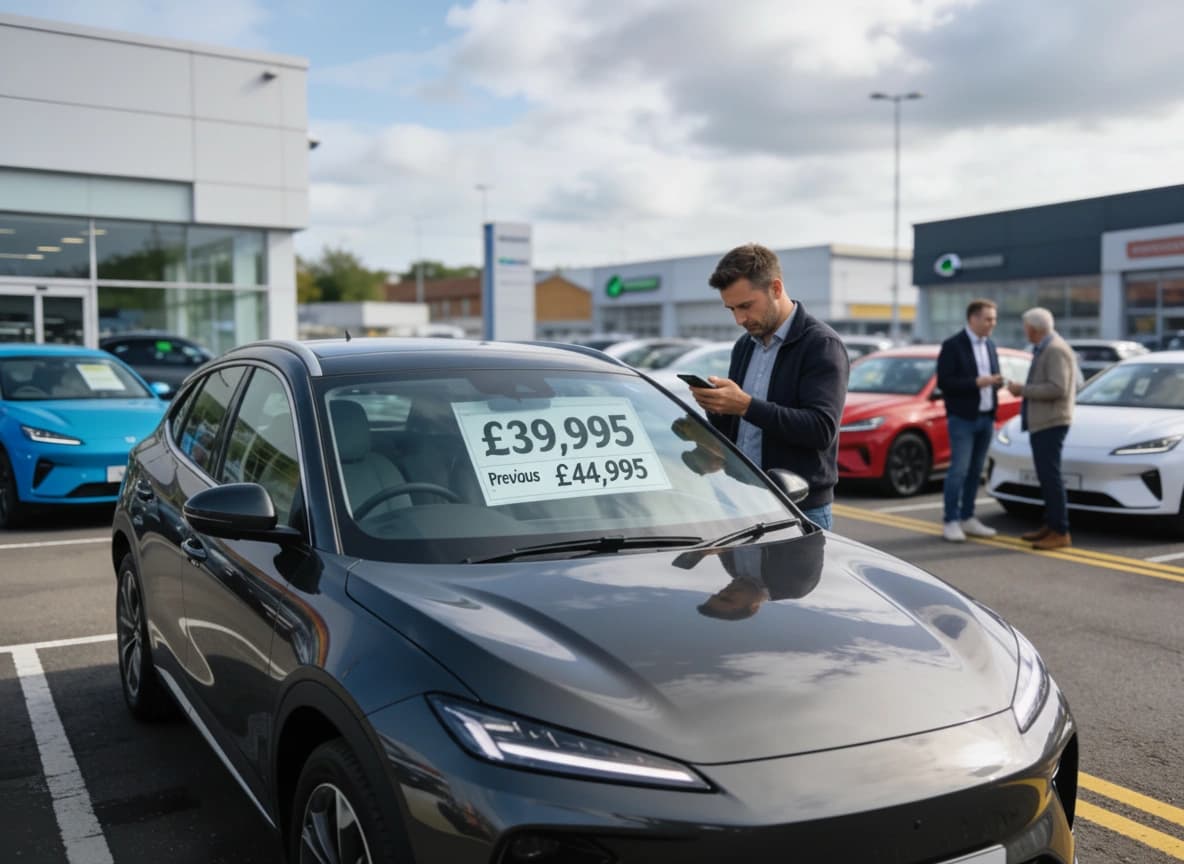
Could today's electric-car discounts affect tomorrow's used values?
Electric-car sales surged in July 2026.
UK registrations of new battery-electric vehicles increased by 44.5% compared with the same month last year, reaching a record 43,106 cars for July and a 27.5% share of the new-car market.
The wider market was strong too. A total of 156,571 new cars were registered in July, up 11.7% year on year, the best result for the month since 2019.
On the face of it, those figures suggest the move to electric cars is accelerating rapidly.
There is another part of the story, though.
Manufacturers have spent much of the past two years using discounts, deposit contributions and subsidised finance to make electric cars more attractive. Even after easing recently, recent analysis put the average discount on a new electric car at around 11%.
For buyers, cheaper cars are clearly welcome.
But there is a longer-term question. If the effective price of a new electric car keeps changing, what does that do to the value of the same vehicle once it enters the used market?
July was the strongest July on record for electric cars
Battery-electric vehicles were one of the main drivers of July's new-car growth.
Registrations rose by 44.5% from 29,825 in July 2025 to 43,106 in July 2026, a record volume for the month.
Market share increased from 21.3% to 27.5%.
Plug-in hybrids also performed strongly, with registrations up 33.6%, whilst conventional petrol registrations fell by 5.2% and diesel registrations dropped 17.7%.
This follows a strong June, when electric cars accounted for 30% of all new registrations.
Across the first half of 2026, 284,579 new battery-electric cars were registered, 26.6% more than during the same period in 2025.
Electric cars are therefore moving steadily further into the mainstream new-car market.
Why are electric-car registrations rising so quickly?
There is no single reason.
More electric models are available than ever before, including smaller and more affordable cars. New manufacturers have entered the UK market, particularly from China, increasing competition across several price ranges.
Higher petrol prices have additionally strengthened the financial argument for switching for some drivers, particularly those able to charge at home.
Government support and manufacturer incentives have also played a part.
But another major influence is regulation.
Manufacturers face a 33% electric-car target in 2026
Under the UK's Zero Emission Vehicle mandate, manufacturers are subject to annual targets that set the proportion of new cars they register that must be zero-emission.
The headline target for cars is 33% in 2026, rising to 38% in 2027.
The system offers various compliance flexibilities, so a manufacturer's legal position cannot be determined solely by comparing its electric market share directly with 33%.
Nevertheless, the mandate creates a strong commercial reason for manufacturers to encourage electric-car registrations.
The Society of Motor Manufacturers and Traders has repeatedly pointed to substantial manufacturer discounting as one of the factors supporting electric-car demand.
In May, battery-electric registrations rose 34.2% and took 27.3% of the market. The SMMT said expanding model choice and sustained competition, particularly manufacturer discounting, were helping drive that growth.
In June, the electric share rose again to 30%.
Electric-car discounts are still large, but they have started to fall
One of the more interesting developments this summer is that electric-car discounts appear to have eased even while registrations have continued to grow.
Analysis by HSBC, reported in August, put the average UK discount on a new electric car at around 11% in July.
That was the lowest average discount since April 2025.
An 11% reduction is still substantial.
On a £40,000 car, an 11% discount is equivalent to £4,400.
But the fact that discounts have fallen while registrations have risen could suggest that buyers are becoming more willing to consider electric cars without manufacturers having to increase incentives continually.
That would be good news for both manufacturers along with existing owners.
It does not, however, remove the effect that discounting can have on used values.
The manufacturer's list price is not always the price buyers actually pay
New cars traditionally have a manufacturer's list price, but the real transaction price can be very different.
Take a hypothetical electric SUV with a list price of £42,000. A manufacturer might layer several things at once. A £2,500 dealer or manufacturer discount, say. A £2,000 finance deposit contribution on top. Subsidised or 0% finance. Perhaps a home charger or charging credit as well.
Depending on how the offer is structured, the effective cost to the customer can be substantially below the headline £42,000 figure.
This matters when the same model appears on the used market.
A used-car buyer is unlikely to judge value solely against an historic manufacturer's list price. They will also look at what a comparable brand-new example costs today.
How can new-car discounts affect nearly-new values?
Imagine someone bought a new electric car last year.
|
Original list price
|
£42,000 |
|
Price paid last year
|
£40,000 |
|
Equivalent new car available today
|
£35,000
|
The one-year-old car is no longer competing with a £42,000 new vehicle.
It is competing with a brand-new one that can effectively be bought for £35,000.
A used buyer would expect a meaningful saving for accepting an older car with some mileage, so the value of the one-year-old example has to adjust accordingly.
This is one reason sharp reductions in new-car transaction prices can feed through to nearly-new and used values.
The example is illustrative rather than a prediction of how any particular model will depreciate.
Does that mean today's EV buyers face another depreciation crash?
Not necessarily.
The relationship between new-car discounts and used values is real, but it is only one part of the market.
Used values are determined by many other factors, too. The supply of a particular model and the level of private demand for it. Battery range and charging speed. Age, mileage, specification and battery condition. The manufacturer's reputation and the cost of finance at the time. And, importantly, the price and quality of the newer models arriving to replace it.
A desirable electric car that is available in limited numbers can hold its value better than a heavily supplied model facing aggressive new-car competition.
Likewise, an older EV can suffer if a replacement model suddenly offers much longer range or substantially faster charging for the same price.
Used EV prices have actually started rising again
This is where the current market is especially interesting.
Heavy new-car discounting has not prevented the wider used-EV market from showing signs of recovery.
Auto Trader reported that the average advertised price of a used electric car reached £24,662 in June 2026.
On a like-for-like basis, that was 1.6% higher than a year earlier and represented the first annual increase in used-EV prices since December 2022.
The greatest improvement was among electric cars aged 3 to 5 years, where average prices rose 8.9% year on year.
There is, therefore, no contradiction in saying that used EV values are becoming firmer overall while heavy discounting can still hurt individual models.
Both can happen at the same time.
Some electric cars will be more exposed than others
The risk is unlikely to be evenly spread across the market.
A model is more exposed where its original list price was high and where large discounts are now widely available. It is more exposed again, particularly when a replacement has just arrived, offering substantially more range for similar money, or when big numbers are coming back off fleet and leasing contracts at the same time. Weakening demand for the brand, or a new competitor heavily undercutting it, pushes it in the very same way.
Premium electric cars have already shown what can happen when high initial prices meet fast technological development and changing demand.
At the other end of the market, more affordable EVs may have less cash value to lose in the first place.
Chinese manufacturers are increasing price competition
Another factor is the rapid growth of newer brands.
Chinese manufacturers have expanded rapidly in Britain, bringing additional models to market at price points that put pressure on established manufacturers.
In July, the Jaecoo 7 and MG HS both appeared among the UK's five best-selling new cars.
That does not mean Chinese cars will necessarily depreciate faster or slower than established brands.
It does mean buyers now have more options when comparing what they can get for a given budget.
If a new entrant offers more equipment, longer range or a lower price, established manufacturers may respond with revised specifications, finance offers or discounts.
Those changes can then feed through into used-car pricing.
What should you look at before buying a new EV?
For someone buying an electric car today, the manufacturer's list price is only the starting point.
Compare the real ‘cash’ price across several dealers and finance offers. Look at the cash price after all discounts, any manufacturer deposit contribution, the APR and the total amount payable, and, on a PCP, the optional final payment.
Then broaden your search. What are nearly-new examples of the same car selling for? Is a facelift or replacement due, or a larger-battery, longer-range version on the way? How heavily is the model already being discounted, and how long do you actually plan to keep it?
A £5,000 discount can make a car much better value to buy.
It should not automatically be interpreted as £5,000 of guaranteed saving, though, because the discount may additionally influence what the vehicle is worth later.
A lower purchase price is not necessarily bad news
It is important not to treat depreciation in isolation.
If two identical cars are worth £20,000 in three years, the buyer who paid £35,000 has lost less than the buyer who paid £40,000.
A strong discount can therefore protect the buyer from some depreciation rather than cause them a financial loss.
The problem is more relevant to existing owners who bought before the new-car price was reduced.
They may find themselves competing in the used market against a much cheaper brand-new version of the same vehicle.
What about PCP finance?
PCP agreements provide another consideration.
The optional final payment, also called the guaranteed future value, is set at the start of the agreement.
If the vehicle is worth less than that figure at the end of the agreement, a customer who has complied with the agreement can generally choose to return the car rather than pay the optional final payment to own it, subject to the finance terms and any applicable charges.
This can reduce the customer's exposure to an unexpectedly weak resale value.
If the car is worth more than the optional final payment, there may instead be equity available towards another vehicle.
Buyers should therefore compare the whole PCP agreement rather than focusing only on the monthly payment.
How do new-car discounts affect Return to Invoice GAP?
The manufacturer's list price and the amount actually paid for the vehicle are not necessarily the same thing.
Return to Invoice GAP is designed around the actual invoice purchase price, subject to the particular policy wording, limits and exclusions.
Consider this example:
|
Manufacturer list price
|
£40,000 |
|
Actual invoice price after discount
|
£35,000 |
|
Later motor insurer settlement
|
£25,000 |
|
Difference from original invoice price
|
£10,000
|
Here, the relevant Return to Invoice benchmark would be the £35,000 invoice price rather than the £40,000 manufacturer list price, subject to the policy terms.
You can only cover back to the £35,000 purchase price, though.
Vehicle Replacement Insurance can work differently
For an eligible vehicle, the cost of replacing it with an equivalent vehicle equivalent to its original age, mileage, and specifications at the time of purchase, subject to the policy wording.
That can produce a different result from Return to Invoice, where replacement prices have changed.
If an equivalent replacement has become more expensive, the replacement benchmark could exceed the original invoice price.
We should be clear: this is not the manufacturer's list price at either the time of the original car purchase or at the time you make a claim. It is the cost of the replacement when you make a claim.
So if the RRP is now £45,000, but discounts mean that the equivalent replacement is now £41,000. It is the £41,000 that a VRI GAP policy will cover you for.
If new and used prices have fallen substantially, the position may be different.
This is why the distinction between original invoice price and replacement cost matters when vehicle prices are moving quickly.
Are EV discounts storing up another depreciation problem?
The evidence does not support a simple ‘yes or no’ answer.
Electric-car registrations are rising quickly. July's 44.5% increase is a substantial change, and the fact that average discounts reportedly fell to around 11% at the same time suggests demand may be becoming less dependent on increasingly aggressive incentives.
At the same time, an average 11% discount is still large enough to change the effective price of a new car materially.
That matters to used values, particularly for nearly-new vehicles bought before those discounts appeared.
The most likely outcome is not a single depreciation story across every electric car.
Some models will hold their values relatively well. Others may come under pressure due to manufacturer discounts, high supply, new competition, or rapid improvements in battery technology.
For buyers, the best defence is to look beyond the list price.
Compare what the car actually costs today, what nearly-new examples are selling for and whether a newer or cheaper version is around the corner.
A generous discount can make an electric car an excellent buy. It can also tell you something important about how the market currently values that car.
Sources and further reading
- Society of Motor Manufacturers and Traders, UK new-car registration data
- SMMT, Huge EV boost in July yet mandate gap persists, 5 August 2026
- SMMT, New car market grows as consumers respond to choice and incentives, 4 June 2026
- GOV.UK, Vehicle Emissions Trading Schemes and ZEV mandate targets
- GOV.UK, Vehicle Emissions Trading Schemes compliance guidance
- The Times, Record electric vehicle sales drive market to seven-year high, 5 August 2026
- The Times, Carmakers cut back discounts on EVs as drivers go green, 1 August 2026
- Auto Trader, Retail Price Index, used EV prices return to growth, July 2026