New Car Prices in the UK: How Much More Are We Paying Ten Years On?
Of course, the modern Qashqai is safer, better equipped and more advanced. But for many buyers, it still fills the same role: a mid-sized family SUV with five seats and a boot. It still gets you to the supermarket and back. But somewhere between then and now, more than £11,500 got added to the price tag, and most people buying one probably haven’t stopped to wonder why.
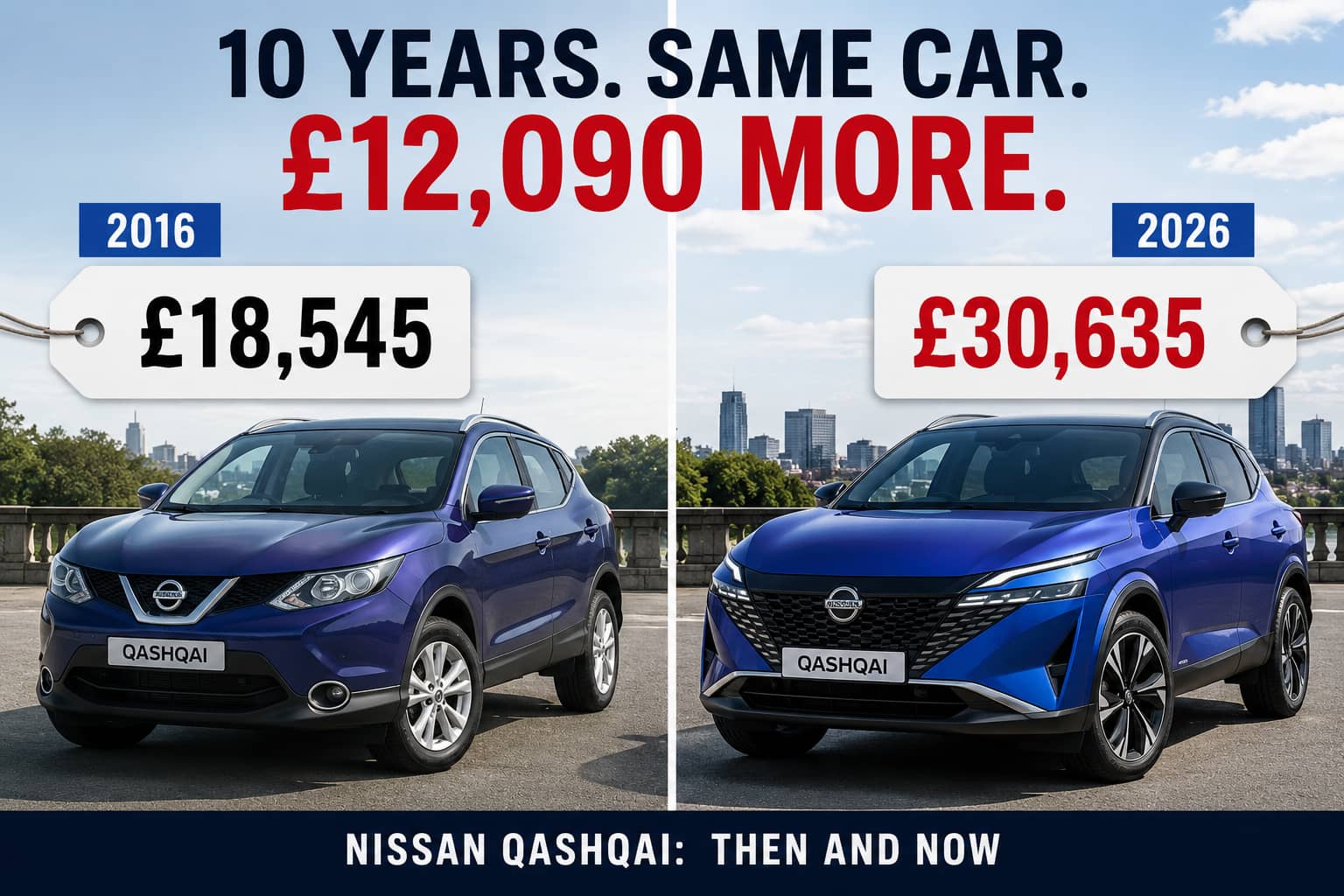
The numbers, because they’re worth sitting with
The Qashqai isn’t an outlier. The
VW Golf, practically a byword for sensible family motoring, started at £17,625 around a decade ago.
Today’s entry-level Golf will cost you £28,910. The Polo, which used to be the cheaper option below the Golf, now starts at £22,040.
A Vauxhall Corsa, the car your mum drove, is £19,740.
Think about that for a second. The average. Not the Range Rover. Not the Tesla. The average.
| Model |
2016 Price |
2026 Price |
Increase |
| Nissan Qashqai |
£18,545 |
£30,635 |
65% |
| Volkswagen Golf |
£17,625 |
£28,910 |
64% |
So what actually happened?
Following the EU referendum, the pound dropped around 10% against the euro almost immediately after the June 2016 vote, and that was always going to hurt in a market where 86% of cars sold in the UK are imported. Manufacturers absorbed some of it. Then they didn’t.
Research by What Car? found prices had risen 5.2% within months of the result. Painful, but manageable. What nobody knew then was that this was only the beginning.
Then COVID hit in 2020. Whilst this impacted all aspects of life, the car market was hit particularly hard. Factories closed. Then the chip shortage continued to impact production even after it could resume. Modern vehicles are technology-driven, and the semiconductor chip shortage led to a collapse in new-car production.
Here’s where manufacturers have to make decisions. Faced with limited production capacity, manufacturers had to choose which cars to build. And they chose the expensive ones. An industry source quoted by Auto Express put it plainly: the profit margin on a £60,000 SUV is roughly ten times what you make on a £15,000 supermini. So the superminis got dropped. Entry-level trim levels quietly disappeared from brochures.
Although supply dried up, people kept buying new cars.
Ford, Mercedes, Renault and others started openly talking about “value not volume”: fewer cars, higher prices, better margins. For a while, some models were selling above list price with no discounts whatsoever. The customer had no leverage.
Layer on top of that the sustained inflation of 2021 to 2023, the cost of electrifying entire vehicle ranges, and higher wages in manufacturing plants across Europe, and you’ve got perfect conditions for prices to go in one direction.
What it’s actually done to people
Simply put, wages in the UK have not risen at the same rate as new car prices.
Average earnings have increased, but not enough to keep pace with the combined effects of inflation and rising vehicle prices. In real terms, wage growth has been modest, while many popular new cars have increased in price over the same period.
Official CPI data puts new-car price inflation at 25% since 2020, though industry analysts at AutoTrader and NimbleFins put the real figure closer to 30-40% once spec changes and model repositioning are factored in.
The gap there isn't small. It is one of the reasons there are now 8.2 million cars over 13 years old on British roads, nearly double the proportion compared to a decade ago.
Many car owners cannot afford an upgrade. They’re nursing ageing motors through MOTs and wishing for the best.
PCP deals, and leases have softened the impact by spreading the cost over several years, meaning many drivers focus on the monthly payment rather than the vehicle's list price. This keeps new cars affordable, even when their list prices have increased.
Is there any good news? Sort of. Discounts have resurfaced in 2025 and 2026 as supply normalised, averaging close to £6,000 on new cars in early 2026. Chinese brands entering the market provide real value too.
The manufacturers’ defence, such as it is
They’re not entirely wrong when they point out that today’s base-spec cars are significantly better than their 2016 equivalents. A standard family hatchback now comes with a large touchscreen, a reversing camera, adaptive cruise control, lane assist, and wireless Apple CarPlay. In 2016, you’d have been paying extra for most of that, if it was available at all.
But here’s the thing. A lot of buyers don’t want any of it. They want something that starts on a cold morning, fits in a normal parking space, doesn’t cost a fortune to insure, and gets them from A to B without requiring a software update. That car used to be priced within reach of most people. Now it barely exists at all. Manufacturers have decided it’s not worth building.
Whether that’s smart business or a slow-motion abandonment of the people who made these brands what they are is probably a question worth asking.
This article was written by Mark Griffiths, Director of Aequitas Automotive Ltd, GAP Insurance expert and car enthusiast. Published 13/6/26