Call Monday-Friday 9am - 5pm Closed Weekends & Bank Holidays




[ Contact Us ]
Need Help? Calling from a mobile please call 0151 647 7556
0800 195 4926Do you have a question? or need help?
Call Monday-Friday 9am - 5pm Closed Weekends & Bank Holidays,
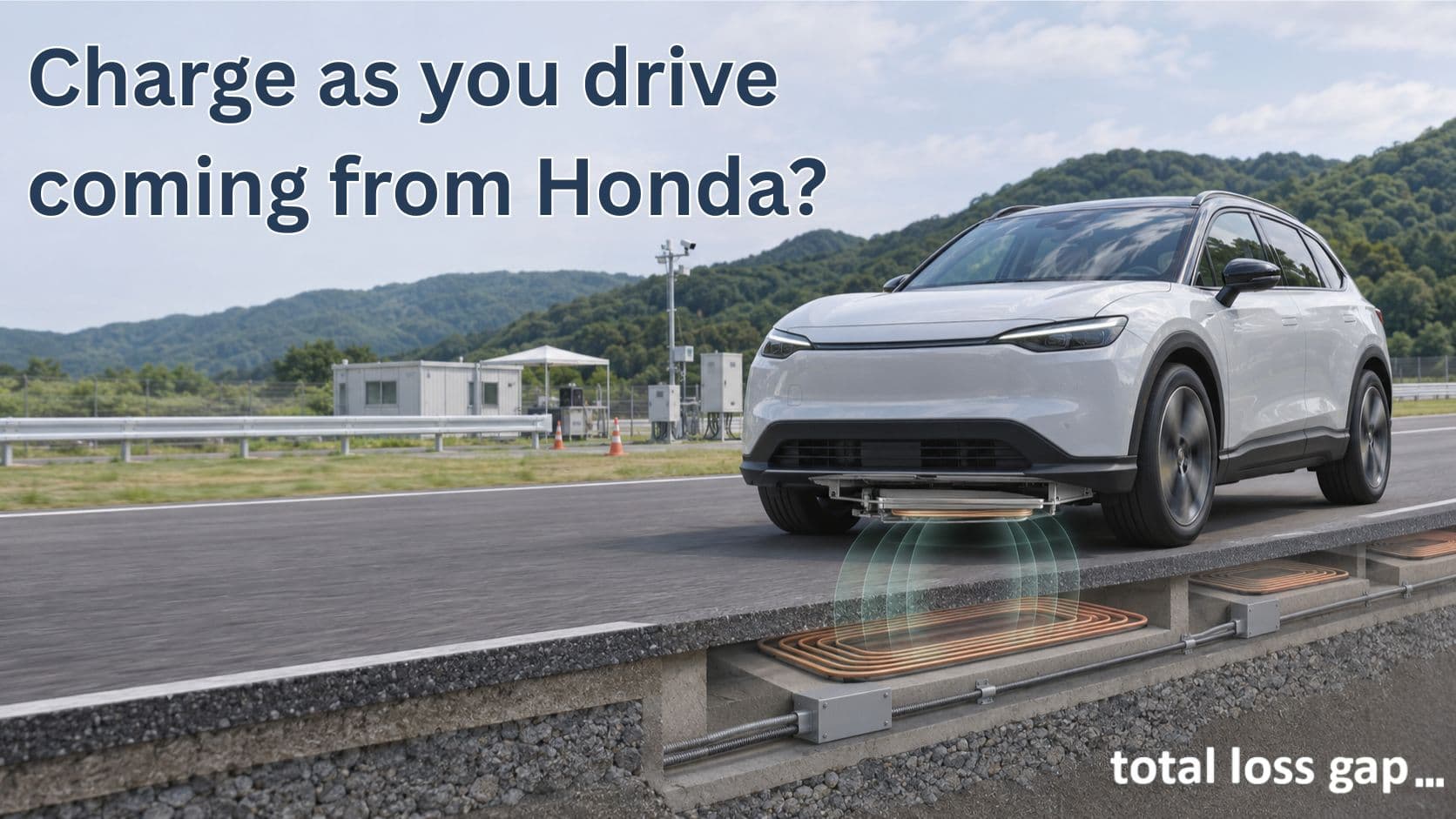 Charging on the move might be on the way......
Honda and its partners want to deliver electricity through the road to moving vehicles. The first trial on a Japanese motorway is planned for the 2027 financial year, which begins in April 2027. Until those trials report, nobody can use the system.
The system uses transmitter units set into the road surface. A receiver fitted under the vehicle picks up the energy through a magnetic field, so there is no cable and no physical contact.
Each road unit combines an inverter and a coil in one assembly. Honda says this is a world first. The units connect to each other through a DC line, which means less wiring to bury. Each unit converts DC to AC internally.
Honda says this should make installation easier. It has not yet published costs, so that claim remains untested.
The road transmits power only when a compatible vehicle is over it.
Three companies, three jobs. Honda's research unit develops the road units and the vehicle receiver. Taisei Corporation builds the DC power supply. Taisei Rotec works out how to fit the system into the road.
The partners have been working together since 2025. Honda has researched wireless power for moving vehicles since 2021.
Honda says the system can deliver up to 150kW, but it describes this as a target that later testing will verify.
So what may that mean in terms of energy?
At 100km/h, a car covers 100 metres in 3.6 seconds. Running at the full 150kW over that stretch would deliver about 0.15kWh, or roughly 1.5kWh per kilometre.
These are our figures, not Honda's, and they ignore transfer losses. They show that route length and coverage matter at least as much as the peak rating.
Honda's testing is staged. It has already carried out experiments at Taisei's Satte site in Saitama. A test road at Taisei's Tamura site in Fukushima Prefecture is planned from late 2026. Those tests will cover:
The public-road trial is the next step. NEXCO East, the motorway operator, plans to install about 300 metres of the Tateyama Expressway mainline near the Kimitsu parking area in Chiba. The trial will run several times from FY2027. A second team of Toyota, Denso and Obayashi is also involved. NEXCO East describes it as the first trial of its kind on a Japanese motorway mainline.
Nothing can be bought or used yet. A car needs receiving equipment, and the road only powers compatible vehicles. Honda says its receivers are designed to suit everything from passenger cars to large commercial vehicles. It also says that if other manufacturers follow the same international standards, their cars could draw power from these roads too. Honda names logistics and trucking as its first market.
Fleet operators face the real question. Would a few hundred metres of charging road on a busy route save enough stops or batteries to pay for the roadworks? The announcements give no costs, and the trials are meant to answer the technical questions first.
How this project progresses may depend on three things: results from the Tamura road, whether the Chiba trial starts in FY2027, and any published installation cost per kilometre.